Lycia, from Xanthos to Myra
The Lycians cut their tombs into the cliffs above their towns, wrote in an alphabet of their own and governed this coast as a league. Their cities, west to east, and the hours of the day that suit them.
Most visitors meet Lycia as the scenery behind a beach on the coast south-west of Antalya. The Lycians who gave it their name spoke a language of their own, an Anatolian one related to Hittite and Luwian, and wrote it in an alphabet adapted from Greek, with half a dozen extra letters for sounds Greek did not have. Most Lycian inscriptions are on tombs. A stone found at the Letoon in 1973 carries a decree in Lycian, Greek and Aramaic, and it helped scholars to read the language.
Three kinds of tomb recur along the road from Xanthos to Myra. House-tombs are cut into cliffs and carved to copy the timber houses the Lycians lived in, down to the ends of the roof beams. Pillar tombs, the oldest kind, set a burial chamber on top of a tall stone shaft. Sarcophagi stand on their own, under tall pointed lids.
Xanthos and the Letoon
Xanthos, the Lycian capital, sits on a hill above the river that shares its name, and its pillar tombs have stood where they are since the sixth and fifth centuries BC. The Inscribed Pillar carries the longest Lycian text known, on all four faces. The reliefs on the Harpy Tomb are casts. Charles Fellows shipped the originals to London in the 1840s, with most of the Nereid Monument, a tomb built like a temple, and both are in the British Museum.
The Letoon, 4 km to the south, was the sanctuary of Leto and her twins, Apollo and Artemis, and the religious centre of the Lycian League; the two sites have been on UNESCO’s World Heritage List together since 1988. Three temples stand side by side, and the lower ruins lie below the river’s water table. The nymphaeum, the fountain house of a sacred spring, is full of frogs and terrapins. The frogs are in keeping: in the story, Leto turned the Lycian peasants who drove her from the water into frogs.
Xanthos is a site to read rather than to look at, so go with someone who can read it. Patara and Xanthos with an archaeologist takes the morning, before the heat, and ends with a swim at Patara.
Patara, where the League met
From the second century BC the cities of Lycia governed themselves as a league. Strabo counted 23 of them with a vote: three votes for the largest, two for the middling, one for the rest. Montesquieu named Lycia as his model of an excellent confederate republic, and in 1787 Alexander Hamilton quoted him in Federalist No. 9, arguing for the new American constitution.
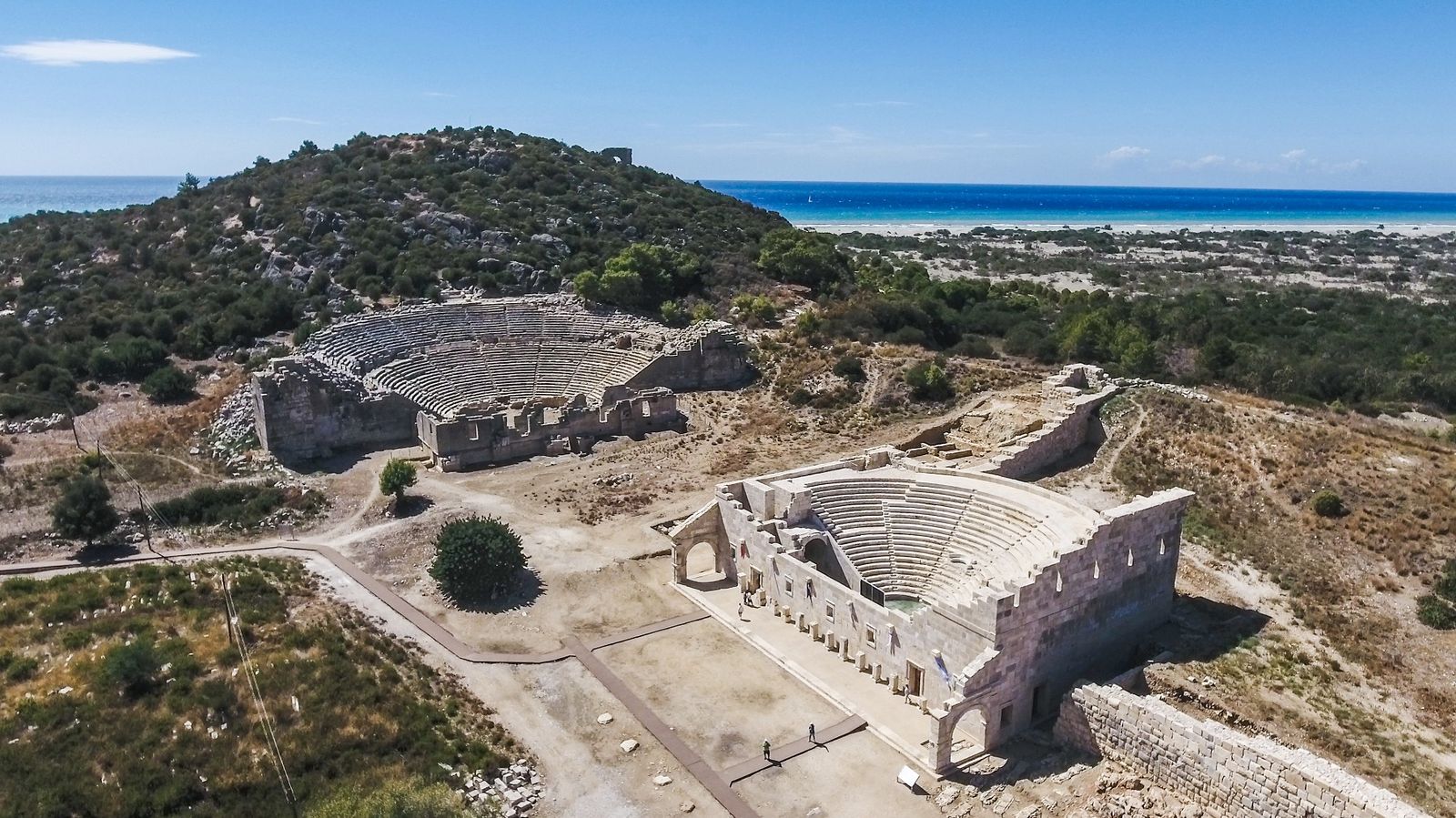
The hall where the League’s assembly met stands north of Patara’s theatre. Türkiye’s parliament paid for its restoration, which was finished in 2012. Nero’s lighthouse, built in AD 64–65 and long since fallen, has been put back together, largely from its own stones, and lit again.
Beyond the ruins lies about 18 km of sand, where loggerhead turtles nest. In the nesting season the beach is closed to people from eight in the evening to eight in the morning.
Kaş, Kekova and Myra
Kaş was Antiphellos, and it shows. A Lycian sarcophagus of the fourth century BC stands at the top of Uzunçarşı, the long street of shops, and the Hellenistic theatre faces the sea and the Greek island of Kastellorizo.
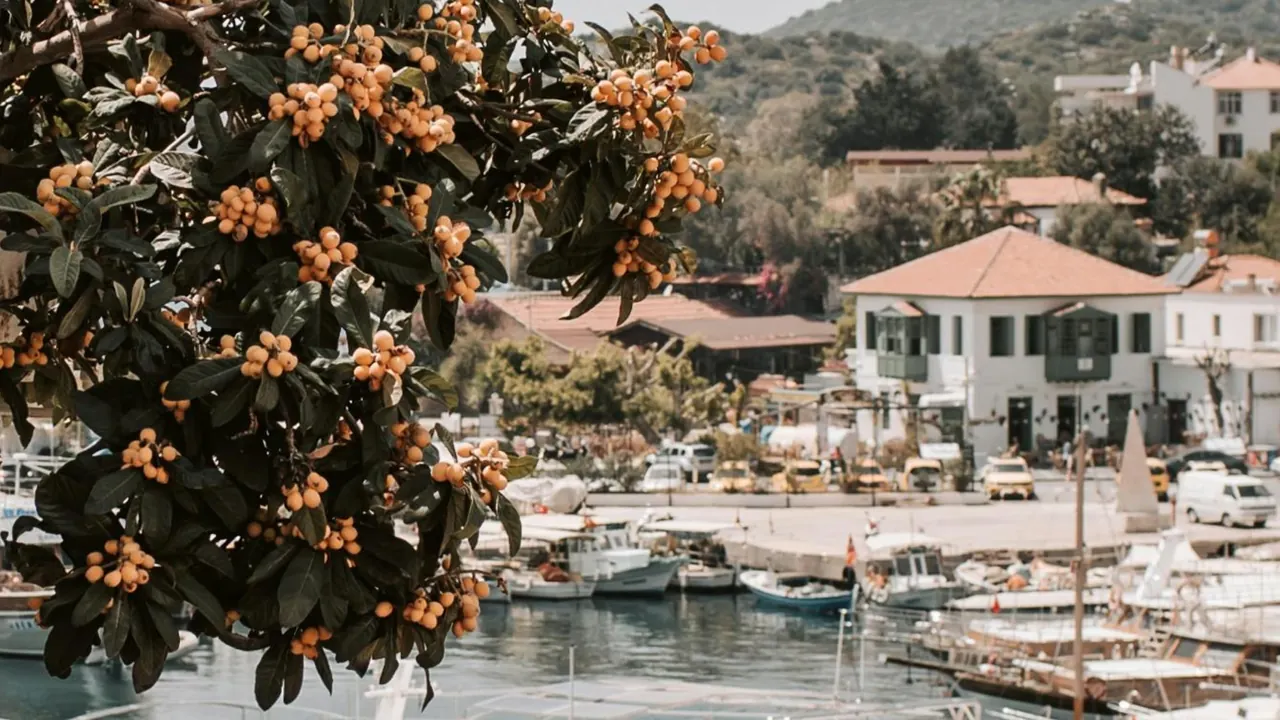
Kekova lies between Kaş and Myra. Along the north shore of the island of Kekova, the walls, steps and house foundations of a town that earthquakes put under the sea lie in clear water. Swimming over them is not allowed, so you see them from the boat. The way to do it is a boat of your own, early: out of Kaş before the day boats, a swim in a bay where swimming is allowed, lunch in the village and back in the early afternoon. The village is Kaleköy, ancient Simena, reached from the sea. Its medieval castle encloses the smallest known theatre in Lycia, its seats cut into the rock, and a sarcophagus stands in the shallows below.
Myra is at Demre, further east. Above its Roman theatre the cliff is cut with house-tombs: a timber town, copied in stone. St Nicholas, born at Patara by tradition, was bishop here in the fourth century, and the church that carries his name, in the modern town, is now a museum.
At either end of the day
There is little shade at any of these sites, so in summer give them either end of the day and never its middle. Go out by boat early, before the coves fill. The archaeologist goes in the morning, before the heat, Myra can wait for the late afternoon, and Patara now also opens on summer evenings, with its lighthouse lit. The hours in between belong to the sea, and to lunch.
Spring and autumn are for walking, on the Lycian Way, which is waymarked in red and white from near Fethiye to the hills west of Antalya.
Stay in Kaş or Kalkan. Kalkan is nearer Patara and Xanthos, Kaş nearer Kekova and Myra, and from either the other half is a day out, so choose one and do not move: no distance on this stretch is worth packing for. The big resorts around Antalya are made for another kind of holiday, and they are a long drive from all of this. The rest of the year, and the rest of the country, are in when to go, place by place.
If you go
- When
- April to November; the sea is warmest from July to September.
- Getting there
- About an hour and a quarter by air from Istanbul, to Antalya or Dalaman. Kaş is nearer Dalaman by road.
- How long
- Four nights in Kaş or Kalkan: one for Kekova, one for Xanthos, the Letoon and Patara, one for Myra, and one for nothing.
- Worth knowing
- At Kekova you see the sunken town from the boat; swimming over it is not allowed.